

English interface
From check-in to weekly recommendation
A 23-second walkthrough of StageLab reviewing a check-in, recommending a prep adjustment, and explaining the change.
Follow your prep plan, compare physique check-ins, and work on your presentation with StageLab. Keep nutrition, cardio, recovery, and progress together from offseason through show day.
Built for competitive physique athletes and prep coaches.
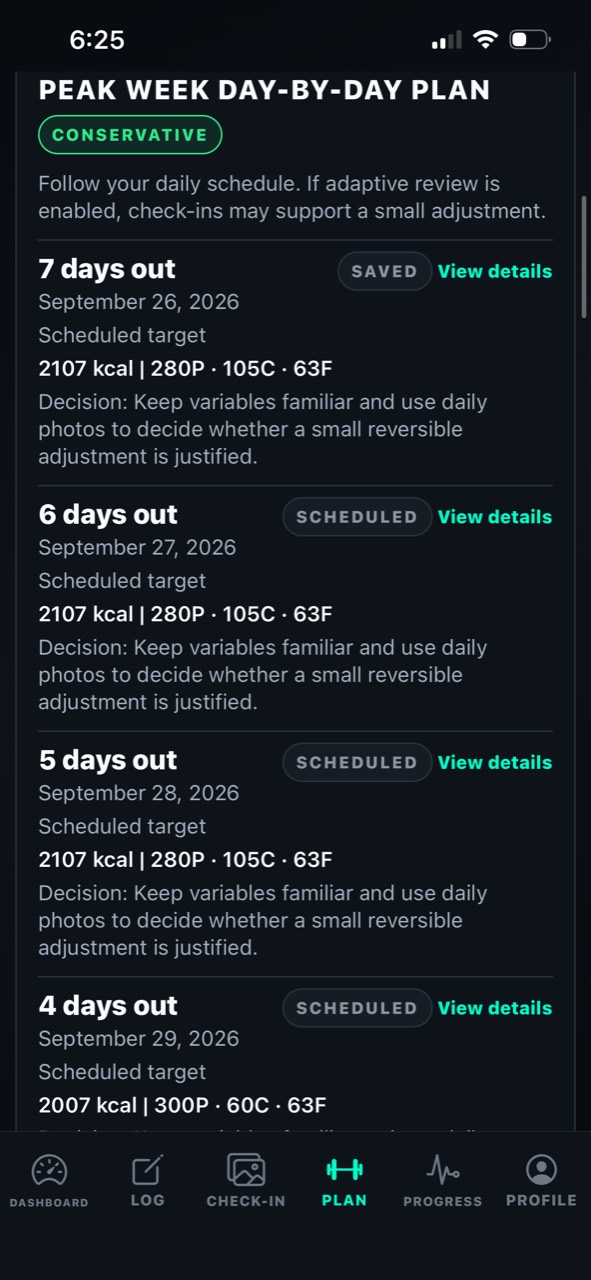
These are current StageLab screens from a competition-prep workflow. The demo video and interface screenshots shown here are in English.
A 23-second walkthrough of StageLab reviewing a check-in, recommending a prep adjustment, and explaining the change.
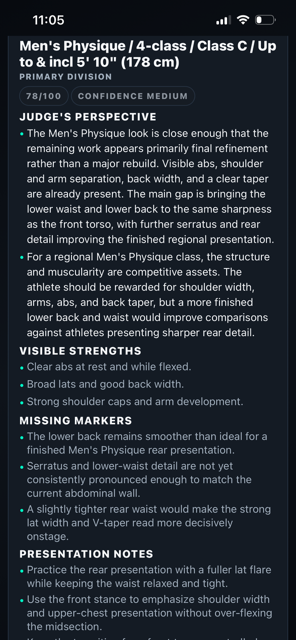
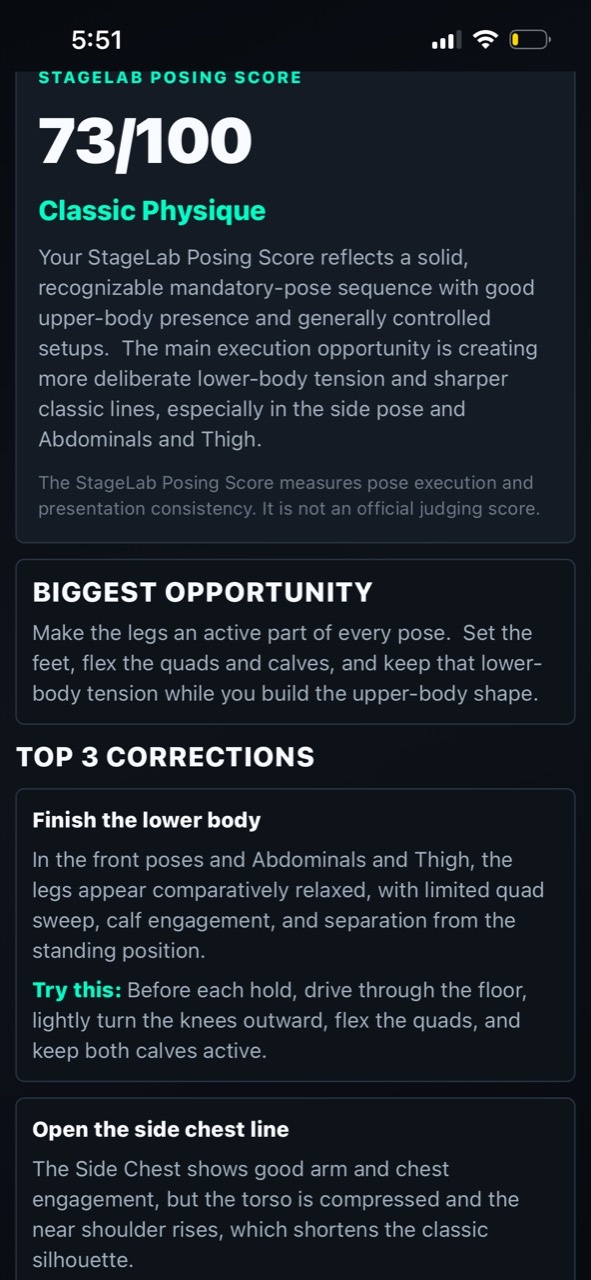
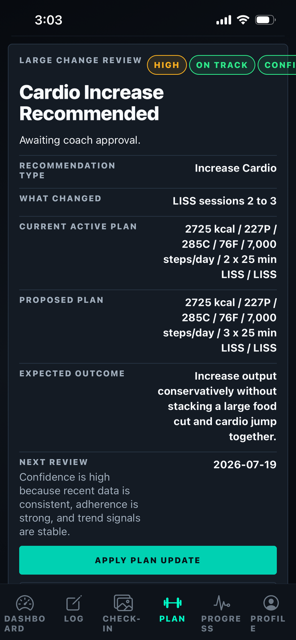
StageLab connects what you do each day with what you review at check-in, while keeping AI assistance clear and each decision open to review.
Keep calories, macros, cardio, steps, training completion, bodyweight, sleep, energy, hunger, and fatigue in one prep record so each check-in has useful context.
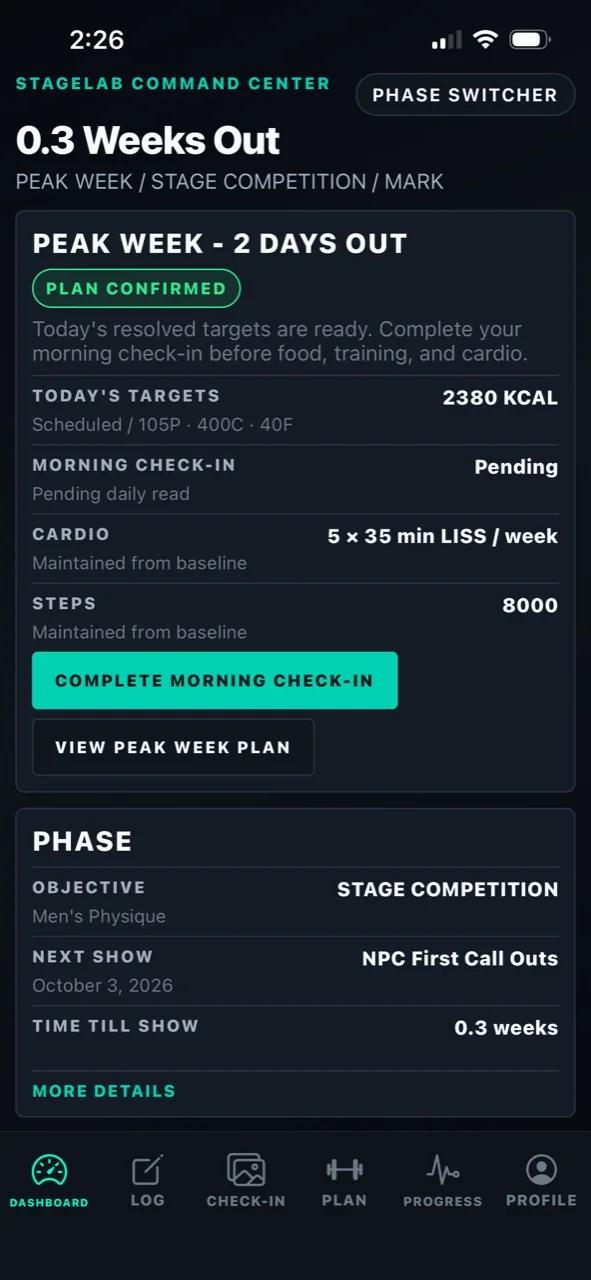
Compare physique check-ins and follow bodyweight and waist trends across prep. When enough comparable history exists, StageLab can add AI-assisted observations about visible changes. Those observations can be incomplete and should be reviewed with the rest of your data.
Upload a short posing video for division-specific feedback on execution and presentation. Review detected poses, strengths, and corrections you can take into practice. Posing feedback is informational and remains separate from physique readiness.
Personalized weekly recommendations use check-ins, adherence, recovery, phase, and plan history to suggest holding or adjusting supported plan variables. Review the reasons and confidence before applying a change.
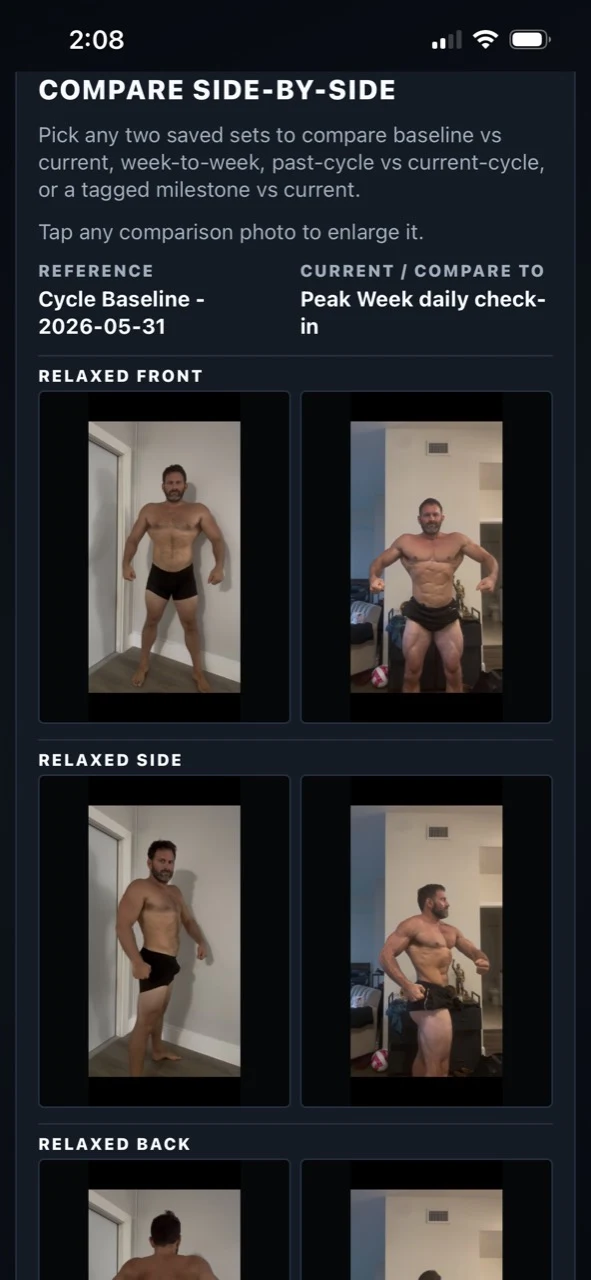
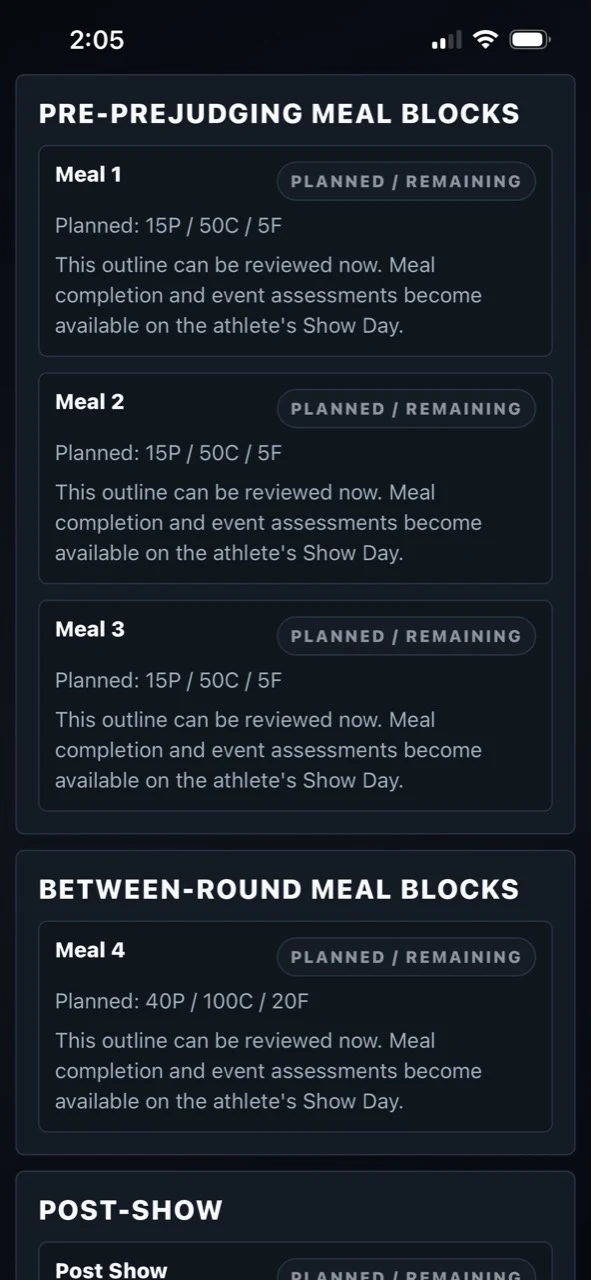
Set your division and competition timeline, keep offseason and contest-prep records, use dedicated Peak Week planning, and organize planned meal blocks for pre-judging, between rounds, and post-show. Continue into post-show guidance without automating dehydration, water cuts, sodium manipulation, or diuretic use.
Use a client dashboard, check-in review, follow-up priorities, StageLab recommendations, invitations, and client management in one workspace. Coaches retain responsibility for their decisions and client relationships.
Explore StageLab for coaches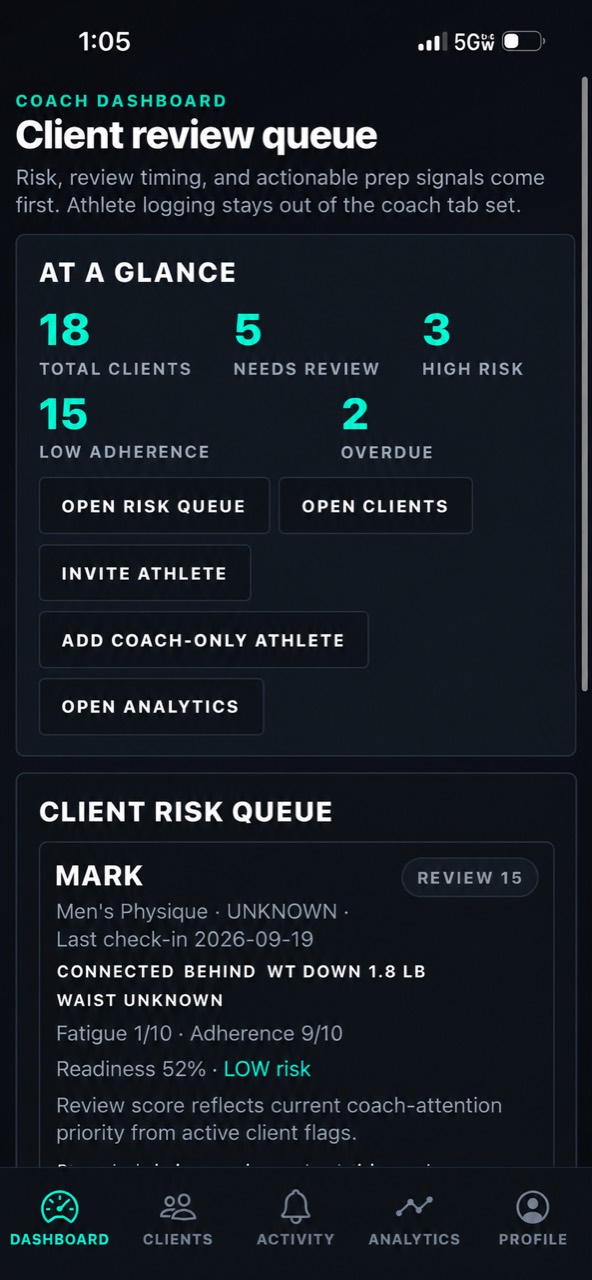
Basic tracking is available free. AI analysis, automated weekly recommendations, advanced history, Peak Week, post-show guidance, and coach tools require the applicable paid access. Current availability and trial eligibility are shown in the app.
Purchase an AI-assisted physique, posing, or combined report directly on the website without downloading the app.
Feedback on visible conditioning, muscularity, and symmetry.
$0.99 USD one time
View analysis: AI Physique AnalysisReview detected poses, presentation, and priority corrections.
$0.99 USD one time
View analysis: Bodybuilding Posing AnalysisBoth reports in one purchase, with physique and posing assessed separately.
Physique + posing$1.49 USD one time
Save $0.49 USD compared with buying both separately.
View analysis: Complete Stage AnalysisNo account or subscription required. These one-time purchases do not include ongoing app coaching, a StageLab Pro subscription, or future app analyses.
AI shouldn't have to be a black box.
StageLab combines logged progress, adherence, recovery, division context, and AI-assisted observations to produce reviewable recommendations. AI supports the assessment; it does not independently control your prep plan, and you review the reasons before applying a supported change.
This describes ongoing competition prep in the StageLab app. One-time website analyses are standalone snapshots: they do not manage a prep plan or establish a progress history.
Conditioning, fullness, muscularity, symmetry, and presentation are considered alongside image quality and available comparison history. Model-assisted observations pass through deterministic checks to produce an estimated readiness range for additional conditioning time.
A readiness estimate is approximate, including when it is expressed as a single number of weeks.
When comparable history exists, StageLab can compare the current check-in with previous check-ins, the cycle baseline, a saved reference or best look, and weight and waist trends. It considers whether the conditioning gap is closing as show day approaches.
A first check-in establishes a baseline. It cannot show a real longitudinal trend.
An estimated body-fat range provides supporting context. It cannot determine stage readiness on its own. A material conflict with stronger visual evidence can lower confidence instead of forcing a seemingly certain answer.
Photo-based body-fat estimates are approximations, not laboratory measurements.
Before suggesting a change, StageLab considers progress, readiness, adherence, recovery, phase, recent interventions, current activity, the maintenance estimate, and safety constraints. It generally favors measured changes, with broader calorie and activity adjustments possible when persistent or urgent evidence supports them.
Being behind does not automatically trigger a calorie cut.
Different divisions call for different looks. Conditioning, fullness, muscularity, symmetry, and presentation are interpreted in the selected division's context, including the possibility of over-conditioning.
StageLab's division standards are coaching heuristics informed by division characteristics. They are not official federation judging criteria.
Photo quality, missing history, inconsistent measurements, pose differences, and disagreement between signals can reduce confidence, widen an estimate, or lead to a more conservative result. Limited evidence may trigger a safer fallback or prevent an unsupported conclusion.
StageLab confidence reflects the quality and consistency of the available evidence. It is not a scientifically calibrated probability.
Available check-in context
StageLab combines model-assisted visual observations with deterministic prep checks and the athlete's division context. Body-fat context supports that review; it does not overrule stronger evidence or become the sole answer.
The result generally describes an estimated readiness range. A single-week estimate, when shown, is also approximate. Conflicting signals can widen uncertainty rather than produce a precise contest-ready date.
Useful comparisons need sufficiently consistent photos and measurements. When those records exist, StageLab can review the previous check-in, cycle baseline, saved reference or best look, and weight and waist trends.
It considers the direction of change and whether the remaining conditioning gap is closing relative to the time left. Missing or poorly comparable history limits that conclusion; a first check-in supplies a baseline, not a demonstrated trend.
StageLab starts with an activity-adjusted formula estimate. When enough reliable data exists, it can incorporate calorie intake from completed logging days and weekly-average weight trends.
The influence of observed data depends on its quality. The system limits abrupt changes driven by noisy short-term fluctuations. This is an adaptive maintenance estimate, not measured TDEE or a precise measurement of energy expenditure.
Recovery, adherence, reported injury indicators, declining performance, recent interventions, and accumulated stress can lead StageLab to hold, soften, or reconsider an otherwise aggressive adjustment.
A measured intervention may need time to show its effect. Persistent or urgent evidence can still support combined calorie and activity changes. These are informational prep safeguards, not medical monitoring or a substitute for qualified care.
As competition approaches, StageLab transitions from normal prep logic into dedicated Peak Week planning. Daily visual and prep context inform that review, rather than simply extending normal weekly adjustments.
StageLab does not automate dehydration, water cuts, sodium manipulation, or diuretic use.
Your physique and how you present it are related, but they answer different questions. Ordered video frames help assess pose execution, strengths, corrections, and presentation in the selected division.
Posing scores do not feed into body-fat estimates, physique readiness, calorie or cardio recommendations, or Peak Week decisions. They do not predict judging outcomes.
StageLab is built for competitive physique athletes and prep coaches who want check-ins, progress, posing, daily prep records, and plan review in one place.
No. StageLab organizes data and provides AI-assisted informational outputs. Athletes and coaches remain responsible for decisions and should seek qualified medical or professional guidance when appropriate.
Basic tracking is available free. AI analysis, automated weekly recommendations, advanced history, Peak Week, post-show guidance, and coach tools require the applicable Pro access. Current plan details and trial eligibility are shown in the app.
No. The physique, posing, and combined website reports are separate one-time purchases. They do not include an app subscription, ongoing coaching, or future app analyses.
No. Recommendations and visual observations may be incomplete or inaccurate. They support review and planning and do not guarantee stage readiness, health outcomes, physique results, judging scores, or competition placement.
StageLab is available on the Apple App Store and Google Play for supported iOS and Android devices.
Download StageLab to keep the work between check-ins connected to the decisions you make next.
Basic tracking is free. Paid features, subscription terms, and trial eligibility are shown in the app.