
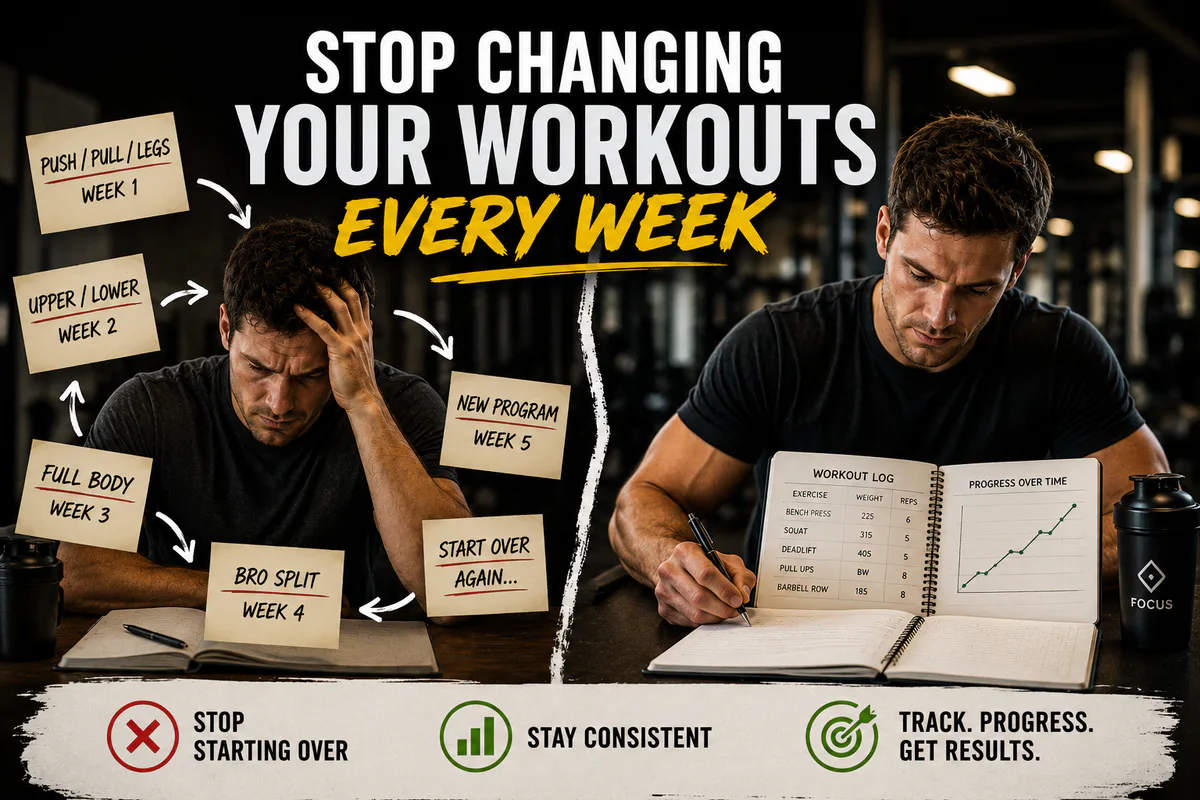
Open Instagram for five minutes and you'll probably see someone claiming they've found the "best" way to train.
One week everyone is switching to Push/Pull/Legs.
The next week it's Upper/Lower.
Then someone with a great physique shares their routine, and suddenly thousands of people are convinced they've been training wrong the whole time.
So they scrap their program and start over.
A few weeks later, they do it again.
If you've ever caught yourself jumping from one workout to another, you're not alone. Almost everyone does it at some point. The problem is that constantly changing your routine makes it almost impossible to know whether it was actually working in the first place.
We Love New Programs
There's something motivating about starting fresh.
A new split, new exercises, maybe even a new notebook or app to track everything. It feels like progress before you've even finished the first workout.
Sometimes that fresh start is exactly what you need.
Most of the time, though, it just replaces consistency with excitement.
A different workout isn't automatically a better workout.
Your Muscles Don't Care About Your Split
This is one of the biggest misconceptions in fitness.
Your muscles don't know if today is chest day.
They don't know whether your program came from YouTube, Reddit, your favorite coach, or the latest fitness influencer.
They respond to training, recovery, nutrition, and time.
That's really it.
There are people building incredible physiques using Push/Pull/Legs.
Others swear by Upper/Lower.
Some train their entire body three days a week.
The split matters far less than how consistently you follow it.
The Problem With "Muscle Confusion"
You've probably heard someone say you need to "confuse your muscles."
That advice has been around for years, and on the surface it makes sense. If your body gets used to an exercise, shouldn't you switch things up before progress stops?
Not exactly.
Your muscles don't get bored.
Your brain does.
If you're gradually asking your muscles to do more than they did before, whether that's another rep, a little more weight, better technique, or more control, they still have a reason to adapt.
Changing exercises every week doesn't magically create new growth.
More often than not, it just makes it harder to tell whether you're actually getting stronger.
Progress Comes From Repetition
Imagine trying to learn guitar by practicing a different song every single day and never repeating one.
You'd learn bits and pieces of a lot of songs, but you'd probably never get very good at playing any of them.
Strength training isn't much different.
If your bench press changes every week, how do you know if you've improved?
If you're constantly replacing squats with different leg exercises, how do you know whether your legs are actually getting stronger?
Repeating movements isn't boring, it's how you measure progress.
Without something to compare against, you're basically guessing.
Progressive Overload Is Simpler Than It Sounds
People sometimes make progressive overload sound like an advanced training concept.
It isn't.
It just means doing a little more than you did before.
That could be:
- One more rep
- Five more pounds
- Better technique
- A slower, more controlled set
- Better range of motion
None of those changes look impressive on their own.
Do them consistently for six months, though, and you'll probably be surprised by how much stronger you've become.
It's Okay to Change Things
This doesn't mean you should do the exact same workout forever.
In fact, making small changes once in a while is a good idea.
Maybe your shoulders feel better with dumbbells than a barbell.
Maybe you've been doing barbell rows for months and want to switch to chest-supported rows.
Maybe you're simply getting a little bored.
That's normal.
Think of your workout like your favorite meal. You don't reinvent it every week. Maybe you change the seasoning, swap a side dish, or cook it a little differently, but the main ingredients stay the same.
Training works the same way.
Keep the foundation of your program consistent, and make small changes when they have a reason behind them. Swap an accessory exercise, try a different variation of a lift, or adjust your exercise order if it helps you stay motivated.
Those kinds of changes can keep training enjoyable without forcing you to start over every few weeks.
Stop Chasing the Perfect Program
The fitness industry loves selling the idea that you're one workout away from your best physique.
That's because "The Perfect Workout" gets clicks.
The truth is a lot less exciting.
Most strong, muscular people didn't get there because they found a secret split.
They got there because they kept showing up.
Week after week.
Month after month.
Year after year.
They got really good at the basics, gradually lifted more weight, recovered well, and stayed consistent long after the excitement of a new program wore off.
It's not flashy.
But it works.
Give Your Program a Real Chance
Before you switch to another workout because someone online says it's better, ask yourself one question:
Have I actually given this one enough time to work?
If you've only been following it for two or three weeks, probably not.
Stick with it.
Track your lifts.
Pay attention to how you're recovering.
Make adjustments when there's a reason to, not simply because something newer showed up in your feed.
The Bottom Line
Most people don't need a completely different workout.
They need more time with the one they're already doing.
Consistency almost always beats constantly chasing the newest trend.
So before you delete your current program and start another one, ask yourself this:
Am I changing it because it stopped working, or because I got bored?
Those are two very different reasons, and knowing the difference can make all the difference in your progress.