
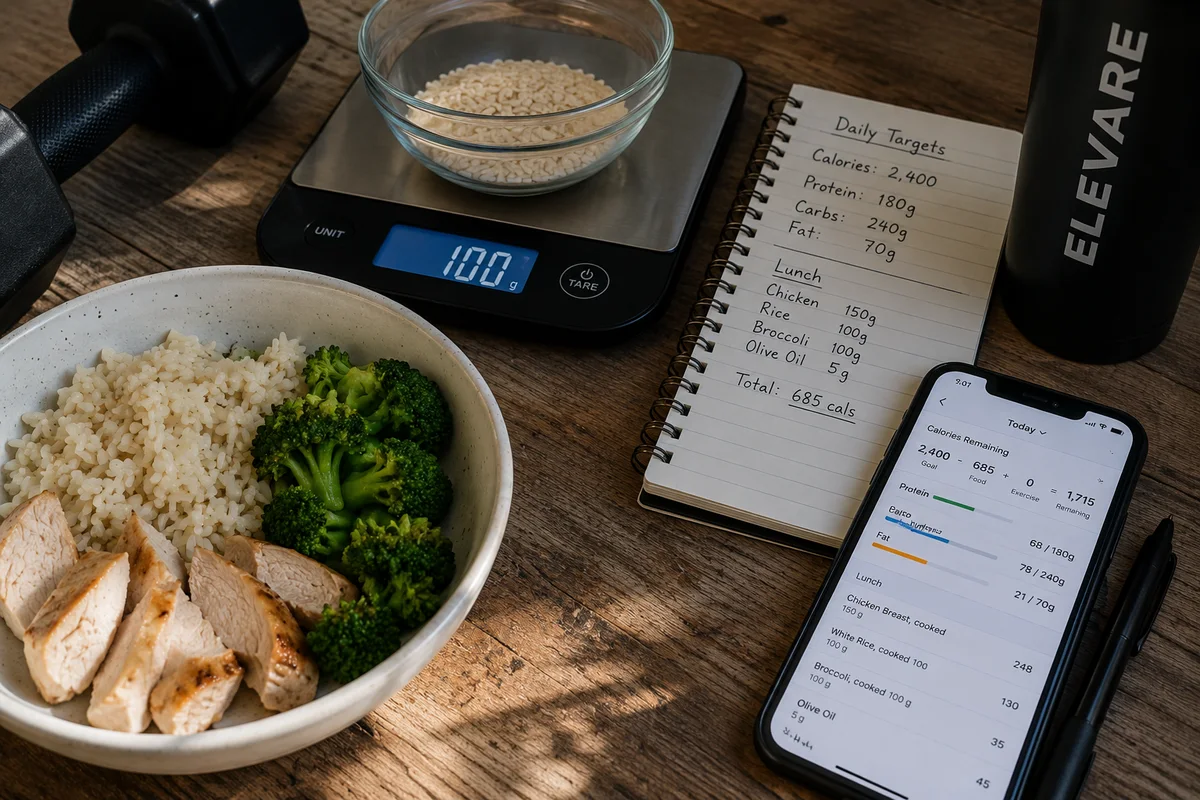
Calorie tracking isn't particularly difficult. Accurate calorie tracking is where people tend to run into trouble.
You can log everything you eat, hit your calorie target perfectly on paper, and still consume significantly more or less than you think. Usually, the problem isn't the tracking app. It's what gets entered into it.
A "serving" of peanut butter can turn into two servings pretty quickly. A bowl of cereal isn't necessarily the serving listed on the box. And logging 150 grams of chicken doesn't tell you much if you weighed it cooked but chose a nutrition entry for raw chicken.
You don't need to weigh every crumb that goes into your mouth. But if you're already taking the time to track your calories, you might as well make the numbers useful.
Here's how I recommend doing it.
Start With a Food Scale
If you're serious about tracking your intake, a cheap digital kitchen scale is probably the most useful thing you can buy.
Measuring cups and spoons have their place, especially for liquids, but weight is usually easier and more consistent.
Take oats as an example. You can scoop out "half a cup" several times and end up with a slightly different amount each time depending on how you fill the cup. If the label says a serving is 40 grams, weighing out 40 grams removes most of the guesswork.
The process is simple. Put your bowl or plate on the scale, hit tare to bring it back to zero, add your food and log the weight.
For most solid foods, I stick with grams. It keeps things simple.
The Tare Button Makes This Much Easier
You don't need to weigh every ingredient on a separate plate.
Let's say you're making a bowl with rice, chicken and avocado.
Put your empty bowl on the scale and tare it. Add the rice.
Rice: 180 g
Log it, tare the scale again and add the chicken.
Chicken: 150 g
Tare it one more time and add the avocado.
Avocado: 60 g
Now you've weighed the entire meal using one bowl.
Once you've done this a few times, it becomes pretty automatic and doesn't add much time to making your food.
Raw vs. Cooked Matters
Raw vs. cooked is probably one of the easiest mistakes to make with calorie tracking.
Cooking changes the weight of a lot of foods because they gain or lose water.
Chicken loses water while it cooks, so it weighs less afterward. Rice and pasta absorb water, so they weigh considerably more after cooking.
The calories didn't suddenly disappear from the chicken or appear in the rice. The amount of water changed.
So keep this simple:
If you weigh a food raw, use a raw nutrition entry.
If you weigh it cooked, use a cooked nutrition entry.
Don't weigh 150 grams of cooked chicken and then log 150 grams using the nutrition information for raw chicken.
The same applies to meat, rice, pasta, potatoes and pretty much anything else that changes weight substantially during cooking.
Personally, I care less about whether someone chooses raw or cooked than whether they're consistent about it. Either method can work.
Use the Package When You Have One
For packaged foods, I usually start with the nutrition label on the actual package.
Say your cereal lists:
Serving size: 40 g
Calories: 150
If you pour 60 grams into your bowl, you ate 1.5 servings. If your tracker lets you enter grams directly, even better—just enter 60 grams.
And remember that the serving size on the package isn't telling you how much you're allowed to eat. It's just the amount the manufacturer used for the nutrition information.
You can eat 25 grams or 75 grams. Just log what you actually ate.
This is why I generally prefer entering an actual weight instead of blindly choosing "1 serving." A serving is only useful if you know what that particular food entry considers a serving.
Be More Careful With the Foods That Are Easy to Underestimate
You don't necessarily need to weigh everything.
If you're pouring 240 mL of milk, measuring 240 mL is perfectly reasonable. The same goes for plenty of other liquids.
Where I'd be more careful is with calorie-dense foods that are really easy to eyeball badly.
Things like:
- peanut butter
- cooking oil
- salad dressing
- mayonnaise
- sauces
- honey
- syrup
- spreads
A little extra doesn't look like much, but it can add up quickly.
There's also a really easy way to weigh things like peanut butter without making a mess.
Put the whole jar on the scale and tare it to zero. Take out however much you're going to use.
If the scale now says -24 g, you used 24 grams.
That's it.
I use the same idea for sauces and spreads. It's much easier than trying to scrape something into a measuring spoon and then wondering how much stayed stuck to the spoon.
And don't forget cooking oil. It's easy to carefully weigh the chicken, rice and vegetables and then pour oil into the pan without ever logging it.
You don't need to pretend you know exactly how much oil remained in the pan versus ended up in the food, but completely ignoring it isn't a great solution either.
How to Track Recipes and Meal Prep
Recipes look complicated at first, but they're actually pretty easy to track.
Instead of trying to calculate every individual portion while you're cooking, calculate the whole recipe.
Say you're making a large batch with chicken, rice, vegetables, sauce and oil.
Weigh and log everything that goes into the recipe. When it's finished cooking, weigh the entire finished batch.
For example, maybe the full recipe contains 3,600 calories and weighs 2,400 grams after cooking.
That works out to:
3,600 ÷ 2,400 = 1.5 calories per gram
If you put 500 grams on your plate:
500 × 1.5 = 750 calories
You can do the same thing with the macros.
If your tracking app lets you save recipes or meals, this gets even easier because you only have to build the recipe once.
One important point here: weigh the finished recipe after cooking. Water loss or absorption can change the final weight quite a bit.
Restaurants Are Going to Be Estimates Sometimes
This is where I think people can take tracking too far.
If a restaurant publishes nutrition information, use it.
If it doesn't, find the closest reasonable entry and make your best estimate.
You're probably not going to pull out a food scale at dinner and dismantle your meal ingredient by ingredient. You don't need to.
When you control the food, you can be pretty accurate. When you don't control it, estimate and move on.
One restaurant meal being off by 100 calories isn't going to ruin anything. Consistently pretending a 1,200-calorie restaurant meal was 600 calories is a different story.
There's a reasonable middle ground.
Don't Confuse Consistency With Perfect Accuracy
A food scale might tell you that you're eating exactly 173 grams of chicken.
That doesn't mean you know the exact calorie content of that chicken down to the calorie.
Different cuts of meat vary. Nutrition labels aren't perfect. Restaurant portions vary. Cooking changes water content. Food databases can have different entries for what appears to be the same food.
That's normal.
The point of weighing your food isn't to turn your kitchen into a laboratory. It's to remove enough guesswork that your numbers become useful.
Let's say you've tracked consistently for a few weeks and your bodyweight is staying about the same at a logged intake of 2,700 calories.
Is your true physiological maintenance exactly 2,700 calories?
Probably not.
But 2,700 is now a useful number because you know what happens when you consistently eat and track that amount.
If you reduce your logged intake to 2,400 while continuing to measure everything the same way, you've created a meaningful change.
That's what matters.
You Probably Won't Need to Weigh Everything Forever
One of the benefits of weighing your food for a while is that you get much better at estimating portions.
After you've weighed 150 grams of rice over and over, you have a pretty good idea what 150 grams of rice looks like.
Same thing with chicken, oats, cereal, peanut butter and the other foods you eat regularly.
Eventually you build some portion awareness.
There are also times when precision matters more than others.
If you're just trying to maintain your weight and eat reasonably well, estimating some meals might be completely fine.
If you're trying to lose a specific amount of weight or you're deep into competition prep, you probably want to tighten things up.
The amount of precision should match what you're trying to accomplish.
Keep It Simple
If you prepare the food yourself, weigh it and log the amount you actually eat.
If it comes in a package, use the package nutrition information whenever possible.
If you weigh something cooked, use a cooked entry. If you weigh it raw, use a raw entry.
Don't forget the little things that are easy to overlook—oil, sauces, dressings and spreads.
And when you're eating somewhere you can't realistically measure everything, make a reasonable estimate and get on with your day.
You aren't trying to produce a scientifically perfect record of every calorie that enters your body.
You're trying to collect consistent enough information that when your weight goes up, down or nowhere at all, you have a pretty good idea what you've actually been eating.
That's what makes calorie tracking useful.