
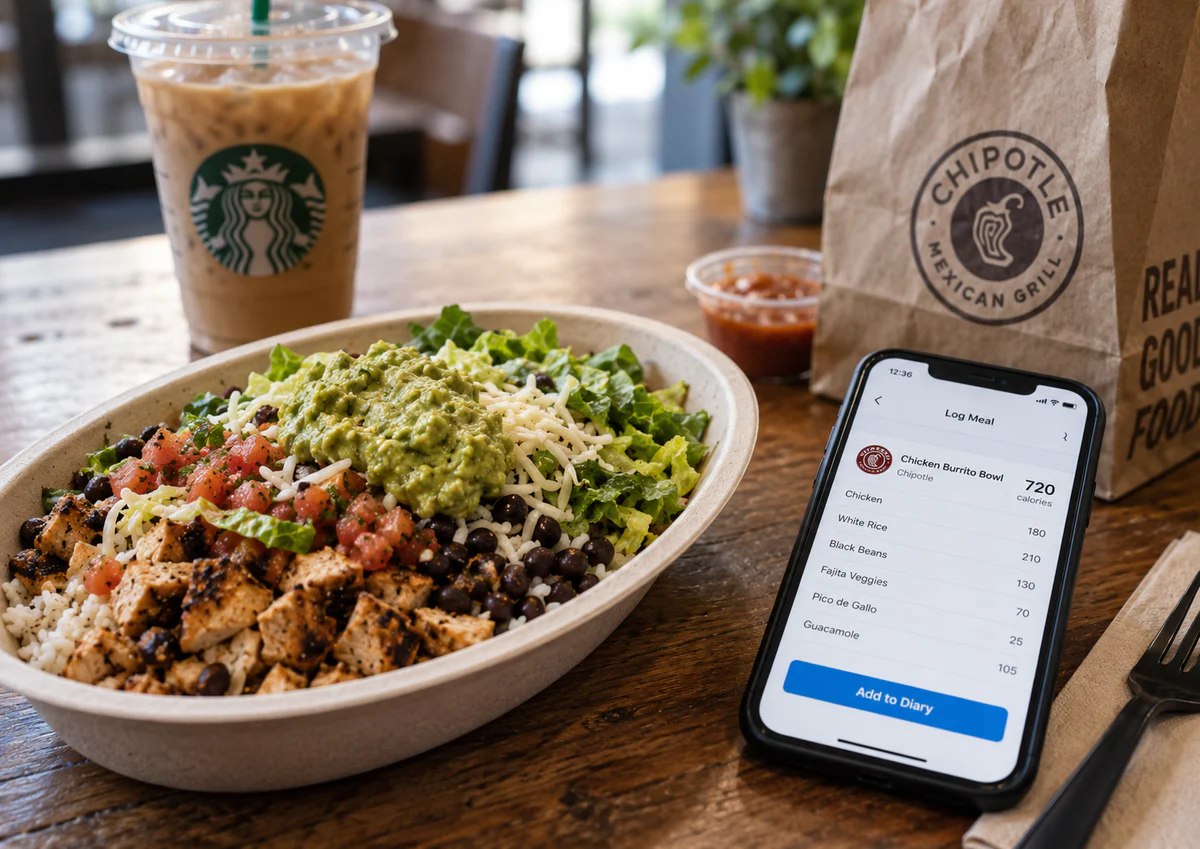
Eating at a restaurant doesn't mean you have to stop tracking your calories.
It just means you have to accept that the numbers aren't going to be as precise as they are when you're standing in your kitchen with a food scale.
I think this is where people tend to go to one of two extremes. They either don't track the meal at all because they don't know the exact calories, or they try to account for every gram of food on the plate and convince themselves their estimate is exact.
Neither is necessary.
If you're eating at somewhere like Chipotle, Chick-fil-A, McDonald's or Starbucks, you can usually get pretty close because there's published nutrition information available. If you're eating at a local restaurant with no nutrition information, you're going to have to estimate.
Both can work.
The goal isn't to know exactly how many calories were in your dinner. It's to make the best estimate you reasonably can and stay consistent with how you track.
Start With the Restaurant's Own Nutrition Information
If a restaurant publishes nutrition information, that's where I'd start.
Major chains like Chipotle, Chick-fil-A, McDonald's, Starbucks, Subway and Panera Bread provide nutrition information for at least much of their menu.
I'd use that before searching for a random entry someone else created in a calorie-tracking database.
There's still going to be some variation. The person making your burrito isn't weighing every scoop of rice before putting it in the bowl, and the amount of sauce on a sandwich isn't going to be identical every time.
That's fine.
The published nutrition information gives you a reasonable starting point.
If the restaurant says the meal is 700 calories, I wouldn't spend 20 minutes trying to determine whether the one sitting in front of you is actually 674 or 738.
Log the best information you have and move on.
Chipotle Is Actually Pretty Easy to Track
Chipotle is one of the easier restaurant meals to track because you're essentially building a meal out of individual ingredients.
Instead of searching for something vague like "Chipotle bowl," think about what you actually ordered:
- rice
- beans
- chicken or steak
- fajita vegetables
- salsa
- cheese
- sour cream
- guacamole
That also makes modifications easier to account for.
If you normally get a chicken bowl but skip the cheese this time, you don't need to find an entirely different food entry. You're just changing one component.
There is one obvious limitation: the scoop you actually receive may not exactly match the restaurant's standard serving.
Anyone who's eaten at Chipotle enough times has probably seen how different two scoops of rice can be.
I still wouldn't try to correct for every slightly heavy or light scoop. If something is obviously different—double meat, a huge portion of rice, extra guacamole—account for it. Otherwise, use the standard nutrition information.
Chick-fil-A, McDonald's and Other Standard Menu Items
Restaurants with standardized menu items are usually straightforward.
If you order a Chick-fil-A chicken sandwich exactly as it comes, use the restaurant's nutrition information for that sandwich.
Same idea with a McDonald's Big Mac or another standard menu item.
Where people get into trouble is forgetting everything around the main item.
Maybe you logged the sandwich but forgot:
- fries
- dipping sauce
- dressing
- cheese
- the drink
- an extra side
Sauces are particularly easy to ignore because they don't look like much food.
But if you're tracking the meal, track the whole meal.
You also want to pay attention to modifications. Removing cheese changes the meal. Adding another sauce changes it. Ordering a larger fry changes it.
You don't need to obsess over it. Just make sure the entry you're logging resembles what you actually ordered.
Starbucks Can Get Complicated Quickly
Coffee itself isn't particularly difficult to track.
It's everything that gets added to it.
A plain black coffee is one thing. A Starbucks drink with milk, syrup, whipped cream, cold foam and other additions is something completely different.
Size matters too.
If you regularly order customized drinks, don't just search for the base drink and assume the calories are close enough.
Pay attention to:
- drink size
- milk choice
- number of syrup pumps
- whipped cream
- cold foam
- sweeteners
- other additions
You don't have to stop ordering customized drinks. You just need to remember that the customization is part of what you're consuming.
And if you order the same customized drink regularly, save it once you have a reasonable entry. There's no reason to rebuild the same drink every morning.
Subway and Other Build-Your-Own Meals
Subway has a similar advantage to Chipotle: you know most of the individual pieces that went into the meal.
You have:
- bread
- protein
- cheese
- vegetables
- sauces
- extras
The vegetables usually aren't where I'd spend most of my attention.
The bread, meat, cheese and sauces are going to matter considerably more.
The same approach works for plenty of other build-your-own restaurants.
Instead of trying to find an exact database entry for every possible combination, break the meal into the major components when necessary.
Panera Bread and Similar Restaurants
With places like Panera Bread, I'd still start with the published menu information.
Then pay attention to what actually came with the meal.
Did you get bread on the side?
Chips?
Soup?
Dressing?
Did you swap an ingredient?
Again, it's usually not the main menu item that causes tracking to go wrong. It's everything else that gets added without being logged.
This is especially easy to do with combination meals where several smaller items don't individually look like much food.
Places Like Five Guys Can Be Easy to Underestimate
A burger and fries are not particularly difficult foods to understand.
They're just easy to underestimate.
A burger can include the bun, multiple patties, cheese, bacon, sauces and toppings. Then you have the fries on top of that.
The problem isn't that you need some complicated formula to track Five Guys.
The problem is looking at a burger and fries and entering something like "cheeseburger – 600 calories" because that sounds reasonable.
If the restaurant provides nutrition information, use it.
Don't let what you think a meal should contain override the information that's actually available.
The Cheesecake Factory Is a Good Example of Why Guessing Can Be Difficult
Some restaurant meals are much more calorie-dense than they look.
The Cheesecake Factory is a useful example because restaurant dishes can contain ingredients you don't necessarily see in obvious quantities—oil, butter, cream, sauces and other additions.
That's why visually estimating restaurant food can be difficult.
You might look at a chicken and pasta dish and mentally calculate the chicken, pasta and vegetables.
But you don't know exactly how much oil went into the pan. You don't know how much butter was used. You don't necessarily know what's in the sauce.
When the restaurant publishes nutrition information, use it.
Your eyes aren't going to give you a better estimate than the information from the restaurant.
What If the Restaurant Doesn't List Calories?
This is where tracking gets more interesting.
Say you're eating at a local Italian restaurant and there's no nutrition information anywhere.
You order grilled chicken, roasted potatoes and vegetables.
You could search your tracker for the individual components and estimate them.
Maybe you estimate:
- chicken
- potatoes
- vegetables
- cooking oil or butter
- sauce, if applicable
You don't need to know whether there were exactly 173 grams of chicken on the plate.
You're trying to get into the right neighborhood.
The biggest mistake I'd avoid is estimating only the obvious ingredients.
Restaurant food often contains more cooking fat than you'd use at home. That's one of the reasons it tastes good.
If you're estimating a restaurant meal and it looks like oil or butter was used, account for some.
Find a Similar Meal When Breaking It Apart Doesn't Make Sense
Sometimes trying to reverse-engineer the entire meal is more trouble than it's worth.
Maybe you order lasagna at a local restaurant.
You're not going to figure out exactly how much pasta, beef, cheese, sauce and oil went into your particular piece.
In that situation, find a similar restaurant-style lasagna entry and make a reasonable portion estimate.
Same thing with:
- pizza
- casseroles
- curries
- burritos
- pasta dishes
- desserts
- mixed restaurant dishes
I'd rather make one reasonable estimate than create 12 individual entries based on guesses and then pretend the result is more accurate.
More numbers don't necessarily mean more accuracy.
Portions Still Matter
Finding the right food is only half of the problem.
You also have to estimate how much you ate.
If you order a huge restaurant portion and eat half of it, don't log the entire thing.
Likewise, if you share an appetizer with three other people, you probably didn't eat the whole appetizer yourself.
You don't need to know whether you ate exactly 26% of it.
Maybe you ate roughly a quarter.
Log a quarter.
This is one of those places where common sense is more useful than fake precision.
What About Tracking Alcohol?
If you're having a drink with dinner, that counts too.
Beer, wine and cocktails can add a meaningful number of calories to a restaurant meal.
Cocktails are especially difficult because the amount of alcohol, mixers, juice, syrup and other ingredients can vary considerably.
If the restaurant provides nutrition information, great.
If not, find a reasonable comparable drink and estimate.
The same rule applies here as everything else: don't pretend the calories don't exist just because they're harder to measure.
Should You Add Extra Calories to Every Restaurant Meal?
I wouldn't automatically add some arbitrary number to every restaurant entry.
If Chipotle publishes nutrition information and you ordered a standard bowl, I'd generally use the published numbers.
If you're estimating a meal from a restaurant with no nutrition information and you know it was cooked with a lot of oil or sauce, then being a little more conservative with your estimate can make sense.
But I wouldn't turn this into:
"Every restaurant meal gets an automatic extra 500 calories."
That's just another form of guessing.
Use the information you actually have.
What If You're Trying to Lose Weight?
You don't have to stop eating at restaurants.
But the more aggressive your goal is, the more useful it becomes to control more of your meals.
If you're maintaining your weight, eating out several times per week and estimating those meals might work perfectly well.
If you're trying to lose weight and the scale hasn't moved for three weeks while you're eating six untracked restaurant meals every week, those meals are an obvious place to look.
That doesn't mean the restaurant food is "bad."
It means there's more uncertainty in the data.
And the tighter your calorie target gets, the more that uncertainty can matter.
Competition Prep Is Different
If you're several months away from a bodybuilding show, you can probably tolerate some reasonable restaurant estimates depending on how your prep is going.
As you get deeper into prep, that changes.
At some point, knowing what actually went into your food becomes more valuable than having another restaurant meal.
That's not because restaurant food suddenly becomes unhealthy.
It's because when you're trying to make increasingly small adjustments, having a large amount of uncertainty in your intake makes those adjustments harder to judge.
For most people tracking calories, this level of precision isn't necessary.
For someone trying to step onstage at a specific level of conditioning on a specific date, it can be.
Don't "Save Calories" by Pretending You Didn't Eat Them
This sounds obvious, but it's surprisingly easy to do.
You have a restaurant meal that you think might have been 1,000 calories.
You don't like that number.
So you find a similar database entry that's 650 calories and log that instead.
Nothing actually changed.
You just made your food log less useful.
Your tracker isn't grading you.
If you ate more than planned, log it as accurately as you reasonably can and continue with your normal plan.
One higher-calorie meal is usually much less of a problem than repeatedly entering numbers you know probably aren't realistic.
Look at the Bigger Picture
Restaurant tracking is always going to have some uncertainty.
That's okay.
If you eat at Chipotle and the actual bowl contains a little more rice than the standard serving, your entire diet hasn't fallen apart.
If you estimate dinner at a local restaurant at 850 calories and it was actually 950, the world keeps turning.
What matters is what happens repeatedly.
If your bodyweight is moving in the direction you expect over several weeks, your tracking is probably useful enough for what you're trying to accomplish.
If you're supposedly eating 2,000 calories every day but your weight isn't behaving the way you'd expect, then it's worth looking at the parts of your diet where you're doing the most estimating.
Restaurant meals are often one of them.
Keep Restaurant Tracking Simple
When you're eating somewhere with published nutrition information, start there.
For places like Chipotle, Chick-fil-A, McDonald's, Starbucks, Subway, Panera Bread, Five Guys, and other major chains, you can usually get a reasonable starting point without guessing the entire meal.
Account for modifications, sauces, sides and drinks.
When you're eating somewhere without nutrition information, either break the meal into its major components or find a comparable restaurant-style meal and make a reasonable estimate.
Don't spend 30 minutes trying to determine whether dinner contained 843 or 887 calories.
And don't give up and log nothing because you can't know the exact number.
The goal is the same as it is when you're weighing food at home:
Get the best information you reasonably can, track it consistently, and use the results over time to figure out whether what you're doing is working.